The École Nationale Supérieure de Statistique et d’Économie Appliquée (ENSEA) has been running a project called “Performance Monitoring for Action” (PMA) since July 2019, with financial support from the Bill & Melinda Gates Foundation n. The project is being implemented with technical support from the Bill & Melinda Gates Institute for Population and Reproductive Health. The objective of the PMA project is to advance knowledge of contraceptive dynamics and reproductive health at a programmatic level.
PMA implements cross-sectional surveys and a longitudinal panel of women and health service sites. The information collected by these panel surveys is not currently measured by other large-scale surveys. The panel design provides unique information by enabling researchers to measure and examine changes in women over time, information that is useful to planners and policy-makers in understanding the demand for and adoption of new contraceptive methods. The data is freely available for research, program planning and policy development.
The project was implemented in two phases between 2020 and 2021. The first phase of baseline data collection from households, women, health delivery sites and family planning clients was carried out from September to November 2020, followed by a follow-up survey in March 2021. The second phase took place from September to December 2021, with a follow-up telephone survey of FP clients in May 2022. The study is being carried out in one hundred and twenty-two (122) nationally representative enumeration zones (ZD) in Côte d’Ivoire, according to place of residence.
In line with the project schedule, the third data collection phase took place 12 months after the baseline survey in the previous phase. As in phase 2, the baseline survey was a combination of a cross-sectional survey of a sample of 35 households per enumeration zone, a follow-up survey of panel women recruited during phases 1 and 2, and a survey of the SPSs serving the DZs.
These operations made it possible to obtain information from women aged 15-49 on the demand for and use of contraceptive methods, on contraceptive dynamics, and to obtain information on the supply and quality of service from the health facilities serving the areas covered by the study. The study also generated quantitative data on gender-based violence within households.
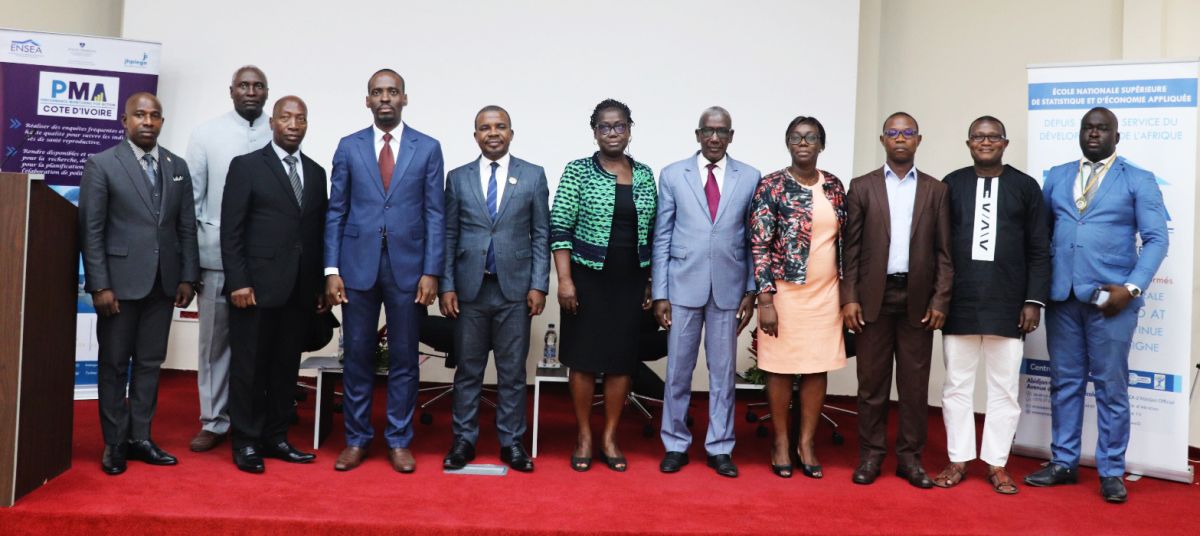
With a view to popularizing the results of these surveys, a national dissemination workshop was held on August 17, 2023 at ENSEA. The workshop was held in a hybrid format (face-to-face and online on Zoom) in order to ensure broad coverage of the various stakeholders.
The overall aim of the workshop was to present the main results of phase 3 of the project and the module on gender-based violence, and to encourage greater appropriation of the survey data at national level. The workshop was attended by :
- the Ivorian government represented by :
- (the representative of the Director General of Health) and Couverture Maladie Universelle ;
- The National Assembly
- Ministry of Youth
- decision-makers in family planning and reproductive health ;
- development partners ;
- experts from the scientific community and civil society;
- and finally the members of the Comité Consultatif de Suivi (CCS).
The ceremony was marked by several highlights:
- speeches ;
- official presentation of study results briefs to authorities and participants;
- presentation of the overall results of phase 3 and of the module on gender-based violence;
- exchanges on results.
Among the results presented, it should be noted that :
- The modern contraceptive prevalence rate (mCPR) among women in union has risen from 19% in 2017 to 27% in 2022.
- The mPCR for girls aged 20-24 is rising, from 27% (2021) to 35% (2022).
- The proportion of users of long-acting contraceptive methods is on the rise: 7% in 2022 versus 3% in 2017.
- Unmet need for family planning is falling, from 26% in 2017 to 17% in 2022. These needs are mainly for birth spacing rather than birth limitation.
- The proportion of unwanted pregnancies is falling, from 43% in 2021 to 40% in 2022. Women who did not want the recent birth or the current pregnancy are mostly in primary school or have never attended school (72%).
- Among women using a modern method at the time of the survey, 79% had discussed the decision to delay or avoid pregnancy with their partner.
- Only 23% of women who benefit from the four key messages that constitute quality FP advice and
- More than one in five women aged 20-24 had discussed FP with a provider in the 12 months preceding the survey. However, teenage girls are half as likely to have had such discussions.
- Just under a third of SPS offering implants do not have trained providers and/or the necessary equipment for implant insertion and removal. For SPS offering the IUD, this rate is 52%.
- The prevalence of physical and/or sexual violence suffered by women at the hands of their intimate partner is high (11%) but down on the results of phase 2 (14%).
- Only 29% of women who have suffered sexual violence have sought help, and in only 4% of cases has help been sought from a formal structure.
- Physical and/or sexual violence perpetrated by an intimate partner is more common among teenage girls (15-19 years, 14%).
These results lead to the following recommendations:
Recommendations related to family planning
- Raise awareness among couples, focusing on men, of the benefits of family planning for the family’s well-being.
- Reinforce or adapt awareness-raising content and approaches.
- Review person-centered counseling approaches.
- Strengthen providers’ counseling skills.
- Popularize e-health platforms to inform adolescents and young people about family planning.
- Pass a law enabling providers to supply teenagers with contraceptive methods.
- Build the capacity of on-site service providers through mobile clinics.
- Make the necessary materials available at all sites.
- Track orders and supplies.
Recommendations on gender-based violence (GBV)
- Increase awareness of the repressive laws on GBV.
- Raise community awareness of the importance of reporting GBV and the various means of redress.
- Strengthen awareness-raising campaigns on GBV.
- Raising couples’ awareness of domestic conflict management.
- Build the capacities of leaders and teenage girls to prevent early marriage.
All these results and those from previous phases of the PMA survey are freely available at www.pmadata.org.